But first, let me talk about what my idea is. Since I'll be teaching Spanish 3, 4 and 5 this upcoming semester, as well as teaching lower and upper level Spanish courses in my future classroom, I thought I really should focus on some upper level Spanish material. I especially took this into consideration because I've already got plenty of experience teaching Spanish 1 and 2 as my teacher assisting placement was in a Spanish 1 and 2 classroom. I have little experience teaching upper level Spanish. In fact, all of that experience comes from long-term subbing in an upper-level Spanish classroom for 2 months. Where I was responsibility for teaching the material, the lesson plans were made by the teacher I was subbing for. So I literally have no experience preparing and planning for an upper-level Spanish course. I have never designed a lesson plan for a class like that. So, I thought, this final project would be a perfect place to start thinking about this.
The first question I asked myself when thinking about what to teach was "What do kids learn in Spanish 3 that's so new and so different that they'd probably freak out on me?" The answer came to me almost immediately: the subjunctive tense. The subjunctive tense does not entirely exist in the English language. There are some traces of it still, but it has mostly weened itself out of the language. For those of you reading who aren't up-to-date on your grammar concepts, the subjunctive tense is a tense that describes desires, wishes, hopes, etc. So, for instance, the one place it still exists in the English language is in the sentence below:
I wish I were (was) a teacher.
In English, we can say either "I wish I was a teacher" or "I wish I were a teacher". Some would argue which sounds better and prescriptivists would surely tell you that "I wish I was a teacher" is the only correct sentence, as I were cannot never be uttered together, but the I were is the subjunctive tense that still lingers on in the English language. In Spanish, however, it is absolutely required. The subjunctive tenses is one of the hardest things to learn as an English speaker since it's a concept they cannot relate to the English language. It's completely new, unheard of, unimaginable. And it's completely vital they learn it adequately in order to be able to completely speak and understand the Spanish language.
Now that you all understand what exactly I'll be teaching in my lesson plan, I will now show you some online resources that I found to help make this lesson plan more technology-enriched. That is, I'll be forgoing the traditional "show the conjugations" on the board and drill, drill, drill. Instead, I'll be looking for ways my students can use technology to better learn this foreign concept in a foreign language. That, and it's vital as Grand Haven High School, where I'll be Student Teaching next fall, is a 1:1 school.
The Resources
Name/title of resource: Creating Travel Advice
URL: Annenberg Learner
How I found it: Through Dr. Siko's blog resources.
How I might use it in my final project: I was looking for a topic where students could use subjunctive frequently and effortlessly. Talking about traveling and giving advice are both great resources for using the subjunctive tense. A deeper investigation into the videos and resources will be required though, but could be the basis for a good introduction into the subjunctive tense.
What standards does the resource address: Standard 1.1: Interpersonal Communication, Standard 1.2: Interpretive Communication, Standard 3.1: Making Connections
Name/title of resource: Spanish Grammar and Humour
URL: Steven French Languages
How I found it: I found it by a good ol' search on Twitter. I simply searched "Spanish subjunctive" and this particular paged stood out above the rest.
How I might use it in my final project: I feel this is something students could really identify with. Memes and funny pictures are all the rage on the internet (is this still a saying they use today, "all the rage"?) There's quite a few Spanish memes using the subjunctive that I have posted below that I think the students will not only understand, but be able to identify with it at a personal level. I mean, who else doesn't demand that weekends be longer? I could use these memes are a source of "examples of the subjunctive tense on the internet", which, in turn, is authentic language use!
What standards does the resource address: Standard 1.2: Interpretive Communication, Standard 3.2: Acquiring Information and Diverse Perspectives

*Please, don't eat me!
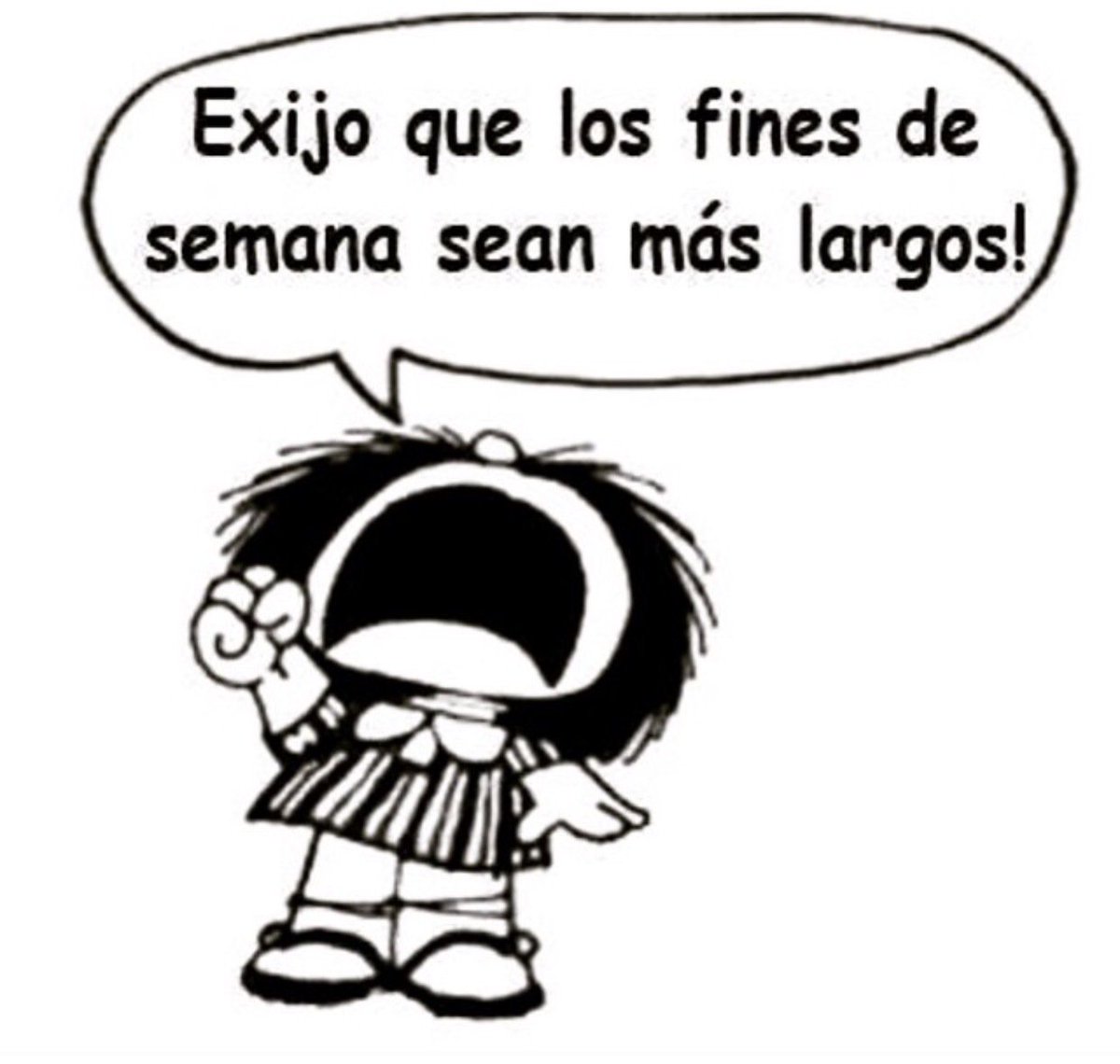
*I demand that the weekends be longer!

*May your dreams influence you more than your excuses.
**The verb here, pesar, means both to weigh and to influence.

*May the Force be with you
Name/title of resource: Introducing the Subjunctive with a Story #11: Unit Plan
URL: Bryce Hedstrom
How I found it: A plain google search. After checking a few sites, this one stood out.
How I might use it in my final project: Before in my Spanish 1 and 2 classes, I have created my own stories when introducing a new grammar concept. Instead of the same old song and dance where the teacher tells the students what the grammar concept is and how it works, by telling the students a story and highlighting the new grammar concepts, the students will then be able to tell me, the teacher, what the grammar concept is and how it works. This has worked famously before and I know it will work great with the subjunctive. After the students learn the concept at a base level, we'll then proceed from there on how to really learn the subjunctive.
What standards does the resource address: Standard 1.1: Interpersonal Communication, Standard 1.2: Interpretive Communication, Standard 1.3: Presentational Communication, Standard 4.1: Language Comparisons

